700 kilometres around the whole coast of Cyprus, on foot, in eight days of July


Every figure about the run itself is computed from the athlete's three raw Garmin fenix 7 Pro activity files, about 514,000 one-second samples. No crew log, no manual entry, no rounding in our favour.
Why the clock is 2 h 52 m longer than the files. The three activity files total 7 d 19 h 42 m 41 s. Twice on the final morning, deep in sleep debt, the athlete stopped and saved his watch by mistake and had to start a new activity. That cost 42 m 21 s of recording the first time and 2 h 10 m 23 s the second. Those minutes happened, so they are in the time. He was stopped for both, and restarted 39 m and 109 m from where the watch had saved, so under 150 m of ground is missing from the distance. This dossier submits gun-to-tape: 7 d 22 h 35 m 25 s.
Three things made it hard, and only two of them are in the data. The heat came first: twenty hours of the week above 35 °C, which is why the middle of it was run at night and slept through in the afternoon — sheets 10 and 11. Then the sleep: the watch was off for 47 hours in eight days, which is the ceiling on how much of that he slept rather than the amount, against the sixty-odd hours eight ordinary nights would hold. The third is in no file. Across the occupied areas of the island phone signal is patchy or absent, so for long stretches the crew could not reach him and he could not reach the crew.
One island, one lap, anticlockwise
Limassol out along the south coast to Cape Greco, north to the tip of the Karpas, back west the length of the north coast, around Akamas, and home down the west and south. Watch it draw, or drag the slider to any point in the eight days.
Where the recording stopped, and whether any route went uncovered
Nineteen breaks of three minutes or more interrupt the trace. For each one we measured the straight-line distance between the last fix before and the first fix after, then asked the question that actually matters: did the track later pass back through the point where it stopped? If it did, the athlete returned to his exact spot and covered the ground. Fifteen breaks resumed within 80 m. These are the other four.
km 202.6 · 235 m offset · 7 h 16 m off watch · 21 Jul 16:57 → 22 Jul 00:13
He resumed 235 m behind where he stopped, not ahead. The offset bears 142° against a travel heading of 318°, so the two are 176° apart, a reversal. The restarted track passes back through the original stopping point 240 m later, to within 0 m. The overnight stop cost him 235 m of ground he then ran twice.
km 646.0 · 109 m offset · 2 h 10 m off watch · 27 Jul 07:36 → 09:47 · device restart
The second accidental save. Again the resume point sits behind him, 150° off his heading, and the track he had already run came within 17 m of where the new file begins. Nothing new was skipped.
km 572.1 · 31 m off watch · 26 Jul 07:00 → 07:31 · Akamas coast
The one genuine hole in the record. The resume point lies 865 m forward along the route (the offset bears 225° against a 235° heading, only 10° apart) and 50 m lower, and the track never returns to the stopping point. So 865 m of coastline is not on the trace. Crossing it inside 31 minutes needs an average of 1.7 km/h, which is slower than a walk: the elapsed time is more than sufficient to have covered it on foot, and no part of it requires assistance. It happened on a stretch that had been redrawn two days earlier, on 25 July, because the planned coastal line did not go through, and the deviation analysis on sheet 05 places this stop inside it. That accounts for his being off the original line here, though not for the 31 minutes off the watch, which stand as recorded.
km 595.1 · 11 m off watch · 26 Jul 16:05 → 16:17
A short forward offset of 84 m, 26° off his heading. Eleven minutes of stopped clock for 84 m of ground.
What the trace establishes about how the distance was covered
Sheet 03 sets out where the record has holes. These four numbers cover the rest of the question: how much route is genuinely unaccounted for, whether the movement looks like a person on foot, what a recount of the raw GPS can and cannot settle, and whether the lap actually closed.
Why re-measuring the track yourself gives 797 km. Summing the distance between consecutive one-second fixes totals 797.18 km, 95 km more than the watch reports, and almost none of that excess is real. Every fix carries a metre or two of error, and adding up half a million short hops accumulates the error instead of cancelling it: across the 111 hours in which the odometer was advancing at all — a looser test than the 107.19 h of moving time on sheet 01, which also requires 1.8 km/h — the geometry sums to 781.08 km where the odometer advanced 700.90 km. A further 16.10 km is invented over 31.7 hours in which the odometer never moved at all and the fix simply wandered. Filtering the noise does not settle it either, because the answer follows the filter — a 5 m minimum-displacement filter gives 782.66 km, 20 m gives 724.72 km, 50 m gives 700.07 km, and nothing makes 50 m more correct than 20 m. The watch's odometer fuses GPS with inertial sensors and rejects the error at source, which is why 701.94 km is the figure claimed here. The GPX filed with the submission is thinned on that odometer rather than on geometry, and measures 701.29 km summed within its recording segments. The ratified FKT carries that same odometer figure. Its route page reads 708.6 km, which is the course as plotted rather than any attempt's measured track, and sits within half a kilometre of the 708.96 km originally planned; the two describe different things, one the line to be followed and the other the ground actually covered.
The attempt was public while it happened. A live tracker carried the athlete's position for all eight days, open to anyone at any hour at andreas365.legendstracking.com. The unit transmits over any available mobile network rather than one carrier's — better coverage than the crew's phones — and where there is no reception at all it stores its fixes and sends them the moment coverage returns, so its record stays complete even where the live feed briefly ran behind him. It ran independently of the Garmin files this dossier is built from, so the two are separate records of the same journey, and the people who followed it are the witnesses to it.
On the device's 31.8 m/s top speed. Ignore it. Only 15 individual one-second samples in the whole run exceed 6 m/s and together they account for 542 m: the signature of GPS spikes, not movement. Sustained speed is the honest test, and over any full minute the run never exceeded 4:32/km.
The line we planned, and the line he ran
We drew the route before the start and exported it again on 25 July with three stretches moved. The comparison is against the plan as it stood at the gun: each of its 13,268 points carries its distance to the nearest point of the track; where that stays over 150 m for 100 m of plan or more, it counts as a deviation, and is measured both ways — the drawn line against the odometer between the same two junctions.
| Plan km | When | Furthest off | Planned | Ran | Difference | |
|---|---|---|---|---|---|---|
| Eighteen stretches | 63.20 km | 47.53 km | −15.67 km |
Nine ran longer than planned and nine shorter; the four over two kilometres are all shorter and carry −16.05 km of the −15.67 km net. The lap still finished only 7.02 km under the drawn route, because over the 645.76 km where the two lines agree his odometer read 654.41 km — 1.3 % more, which is what a measured track does against a line drawn down the middle of a road.
A second device, at six points on the coast
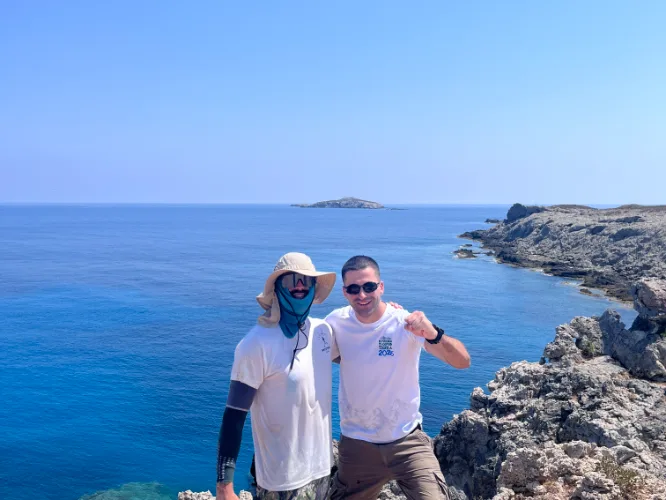
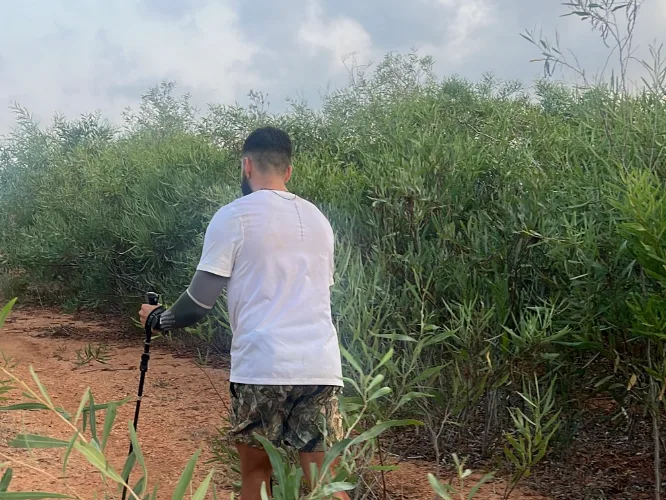
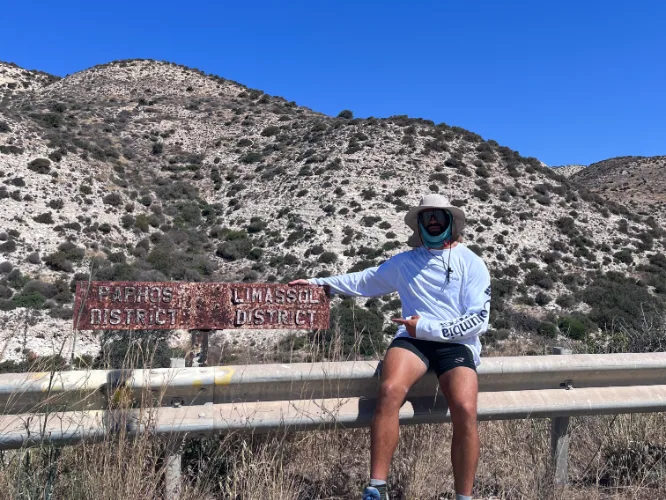
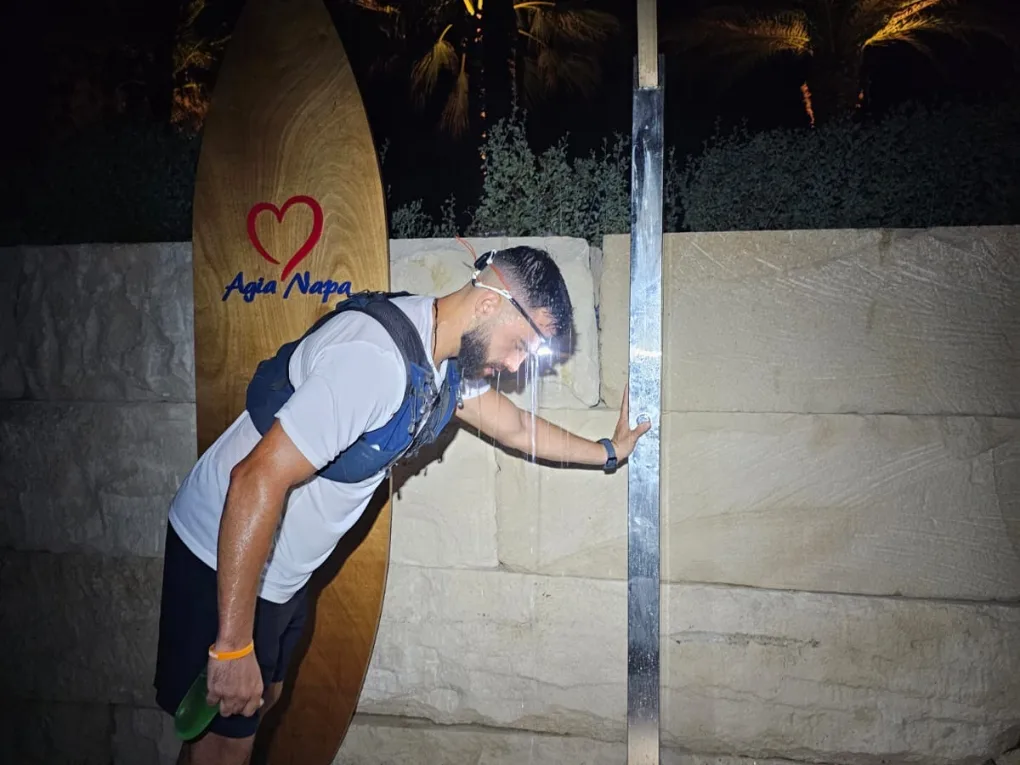
These six photographs are iPhone originals that still carry their EXIF block: the instant the shutter opened, in Cyprus wall time, and the phone's own GPS fix. That makes them a positioning source with no connection to the Garmin. For each one, the watch's position at the same second was looked up in the raw stream and the two compared.
Eight days, none of them under 73 km
| Day | Distance | Moving | Moving pace | Gain | Cumulative | |
|---|---|---|---|---|---|---|
| Total | 701.9 km | 107.19 h | 9:13/km | +6,163 m | 701.9 km |
Two elevation numbers, both honest. The gain column recounts the barometric trace with a 5 m threshold and totals 6,163 m. The watch's own algorithm counts smaller oscillations and reports 8,505 m, which is what the watch itself displays and the figure comparable to every other runner's numbers. Neither is wrong; they measure differently, so both are on this page.
The cost, per hundred kilometres
Pace bled steadily from 7:01 to 10:48 per kilometre across the first six hundred kilometres. Cadence fell with it but bottomed sooner, at 116 steps a minute in the fifth hundred — a collapse in gait, not just effort — and was climbing again while the pace was still going. In the last hundred both recovered together.
A deliberate positive split
He reached halfway at km 351.0 in 3 d 13 h 59 m 48 s, only 45.1 % of the final clock. The second half took 4 d 8 h 35 m 37 s, eighteen and a half hours longer than the first. For an eight-day effort in Cypriot July that front-loading is the plan, not a mistake: bank distance while the legs and the weather still allow it.
And then he sprinted
The final 1.94 km came in at a moving pace of 7:24/km, nearly two minutes a kilometre quicker than his moving average for the week, run after seven hundred kilometres. The last twelve hours and fifty-five minutes of the attempt contained no break of even an hour.
Sea level mostly, and one mountain on day six
Twenty hours above 35 °C
The watch logged ambient temperature throughout. This is a Cyprus July, and the numbers are the reason he ran at night. An independent weather record, drawn over the same axes, says the watch was not exaggerating it.
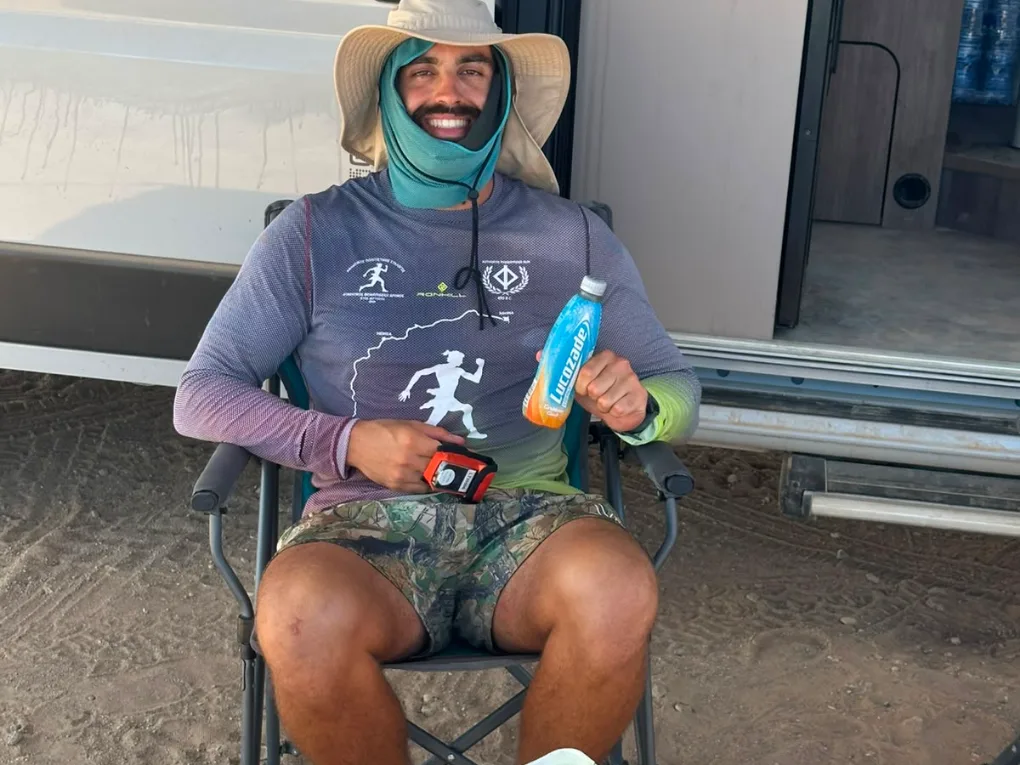
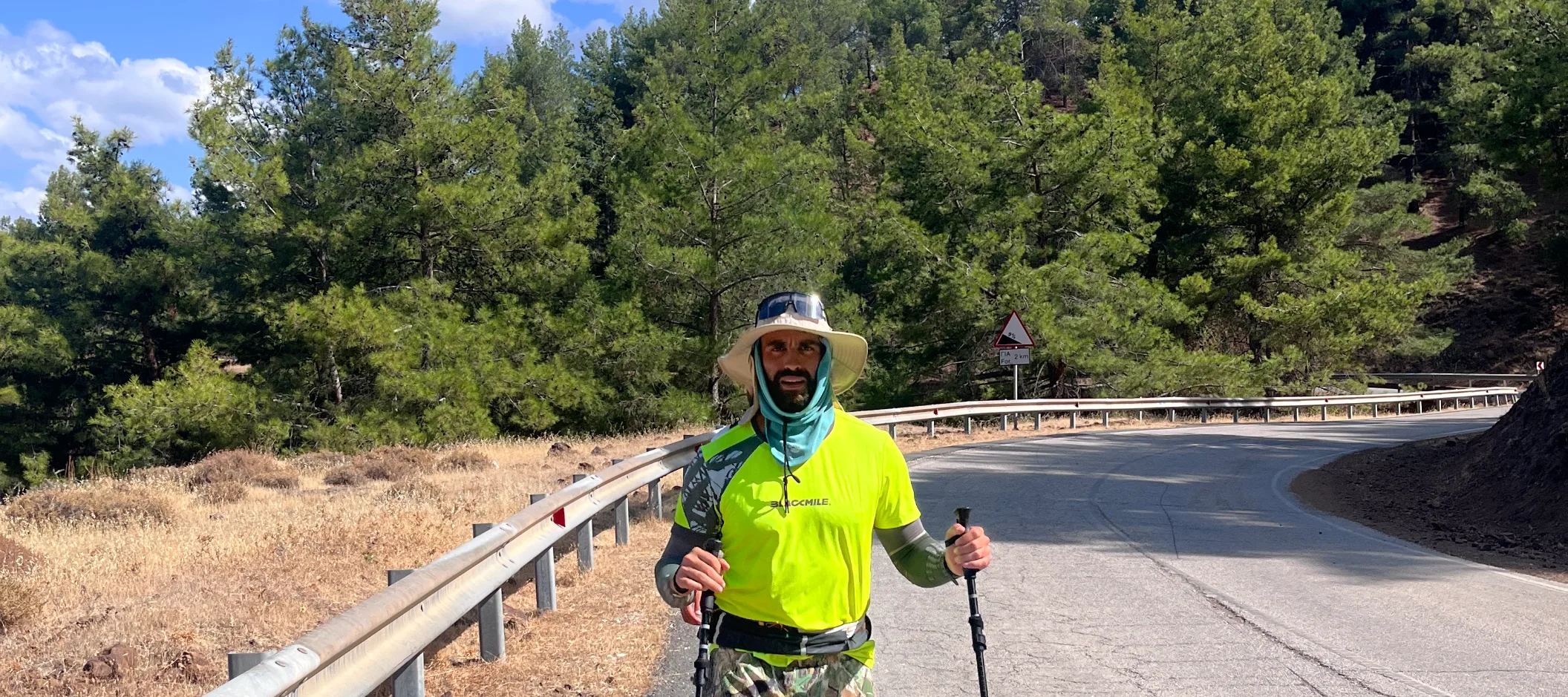
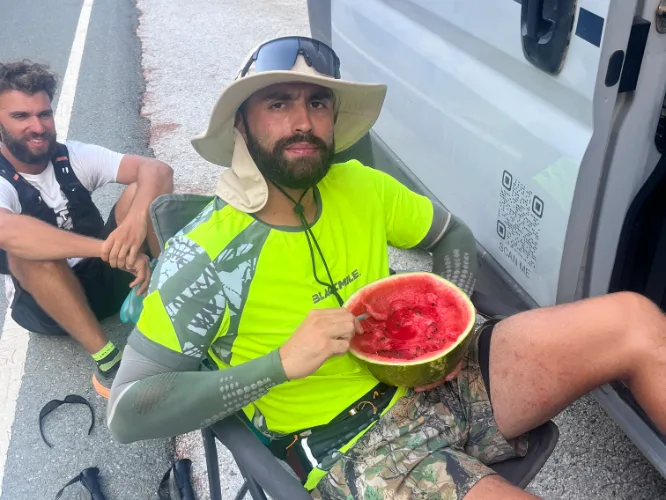
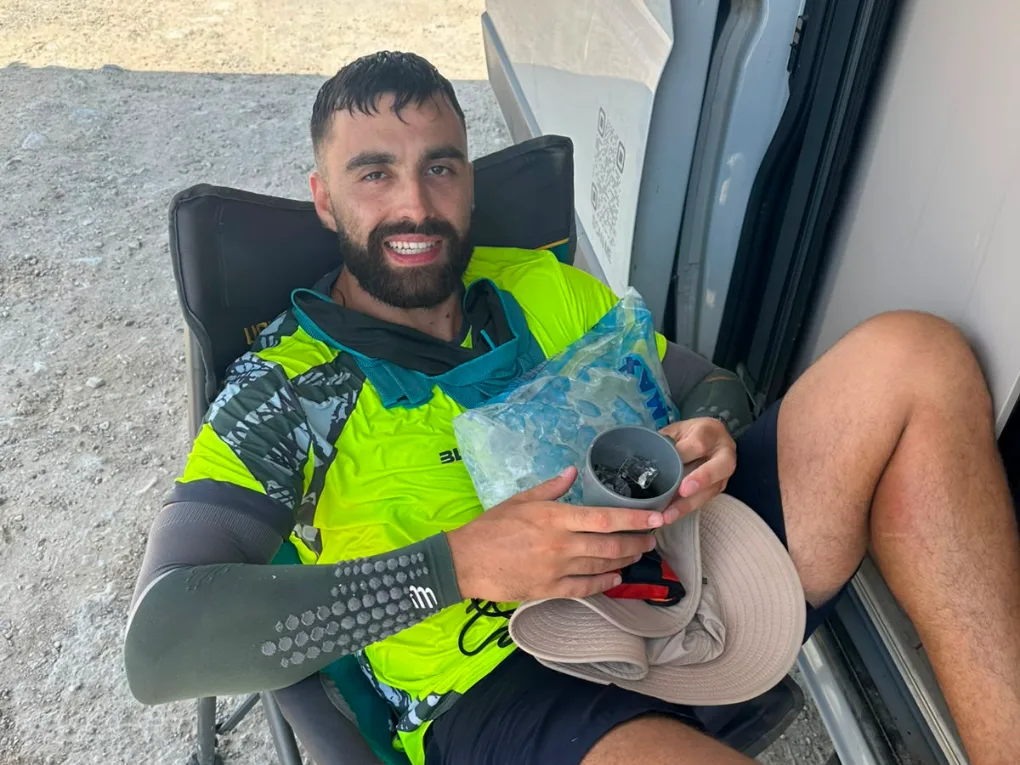
Wide brim, neck and forearms covered, every stop taken in the shade of the van, and a drink in hand at each of them. The temperatures on this sheet are the watch's own sensor, worn on a wrist in the sun; sheet 15 explains why the ambient record is quoted beside every one of them.
Sleep in the afternoon, run in the dark, until it stopped working
Seventeen times in eight days he stopped the watch for twenty minutes or longer, 47 h 09 m in all. That is what this sheet counts — the sleeps and the long halts, not the stops. Crew stops ran to twenty-odd a day, kept the clock running, and not one of them reached twenty minutes; they are inside the 31.7 hours of standing still that sheet 04 counts instead. The shape of the seventeen is the strategy: for four days he took a single long sleep in the worst of the afternoon heat and ran through the night. From day five the long blocks disappear and what is left is fragments.
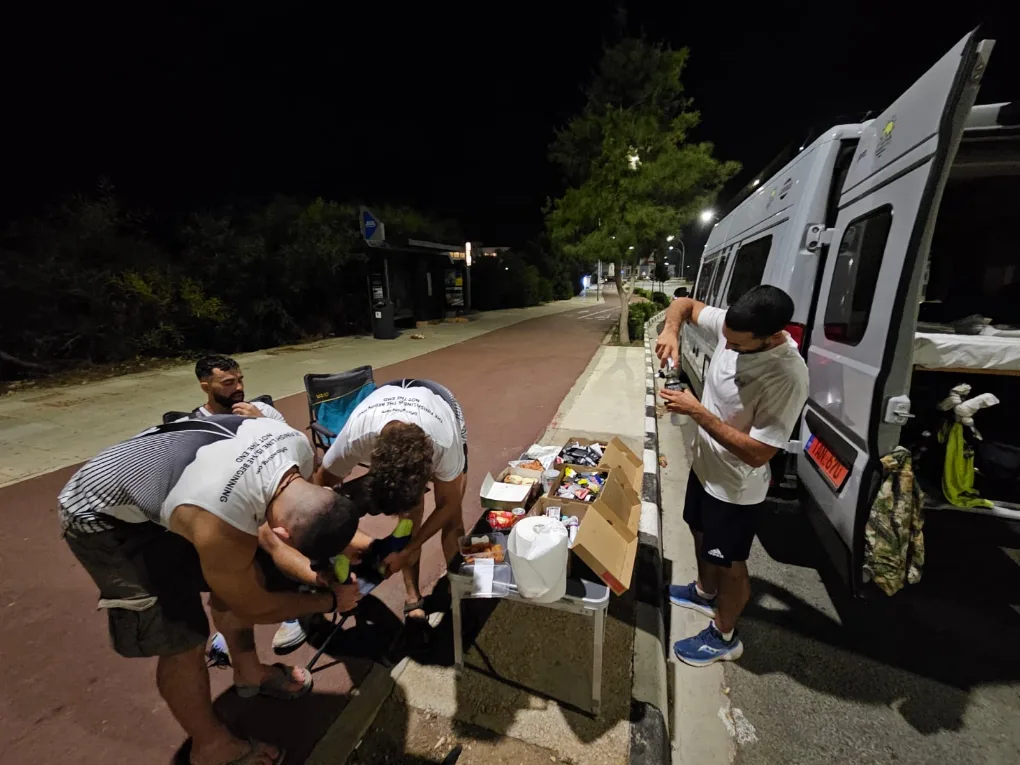
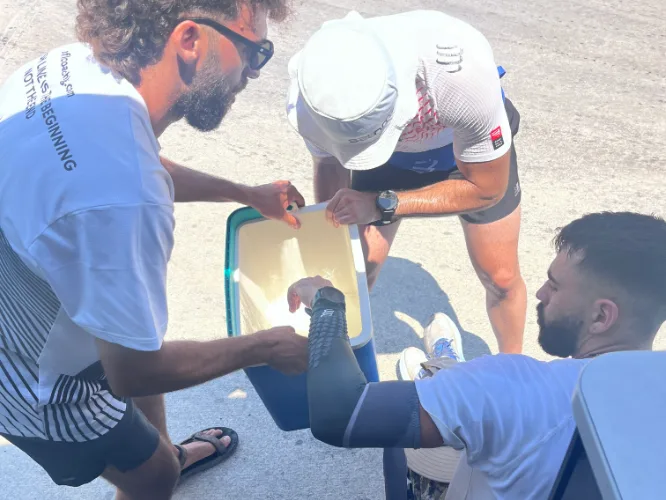
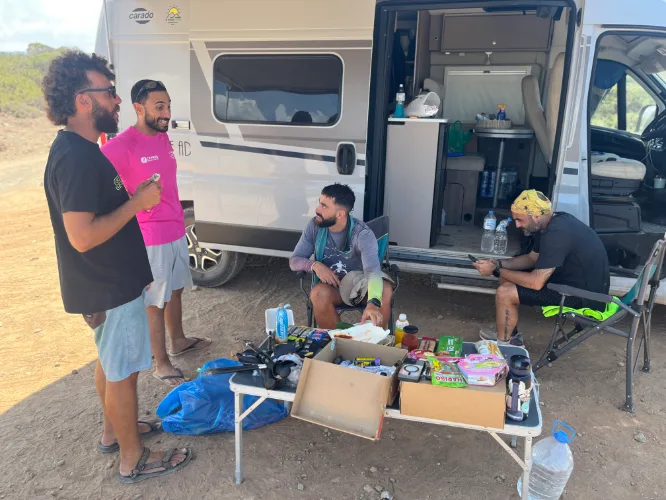
The van, a table, and whatever the next stretch needed. Most ran to a few minutes with the watch still recording; the seventeen blocks charted above are the times it was switched off for twenty minutes or more. Nothing here is timed by hand — a block runs from the last sample before the gap to the first one after it.
The best of every distance, found inside the run
Rolling windows across all 514,000 samples find the fastest any of these distances was covered at any point in the eight days, and the most ground covered in any window of that length.
| Distance | Time | Pace |
|---|---|---|
| 1 km | 5:53 | 5:53/km |
| 5 km | 31:44 | 6:21/km |
| 10 km | 1:09:16 | 6:56/km |
| Half marathon | 2:33:48 | 7:17/km |
| Marathon | 5:16:24 | 7:30/km |
| 100 km | 13:50:44 | 8:18/km |
| Window | Distance | Rate |
|---|---|---|
| 12 hours | 88.93 km | 7.41 km/h |
| 24 hours | 110.66 km | 4.61 km/h |
| 48 hours | 202.62 km | 4.22 km/h |
| 72 hours | 282.57 km | 3.92 km/h |
| Final 24 hours | 85.31 km | 3.55 km/h |
| Final 100 km | 28 h 42 m | 3.48 km/h |
The best 24 hours were the opening ones. 110.66 km, over a window running from seven minutes after the gun to fourteen minutes past midnight on 21 July. Sheet 07's ledger cuts day one at midnight instead, which is why the same running reads 109.5 km there. No day after it came in under 73 km.
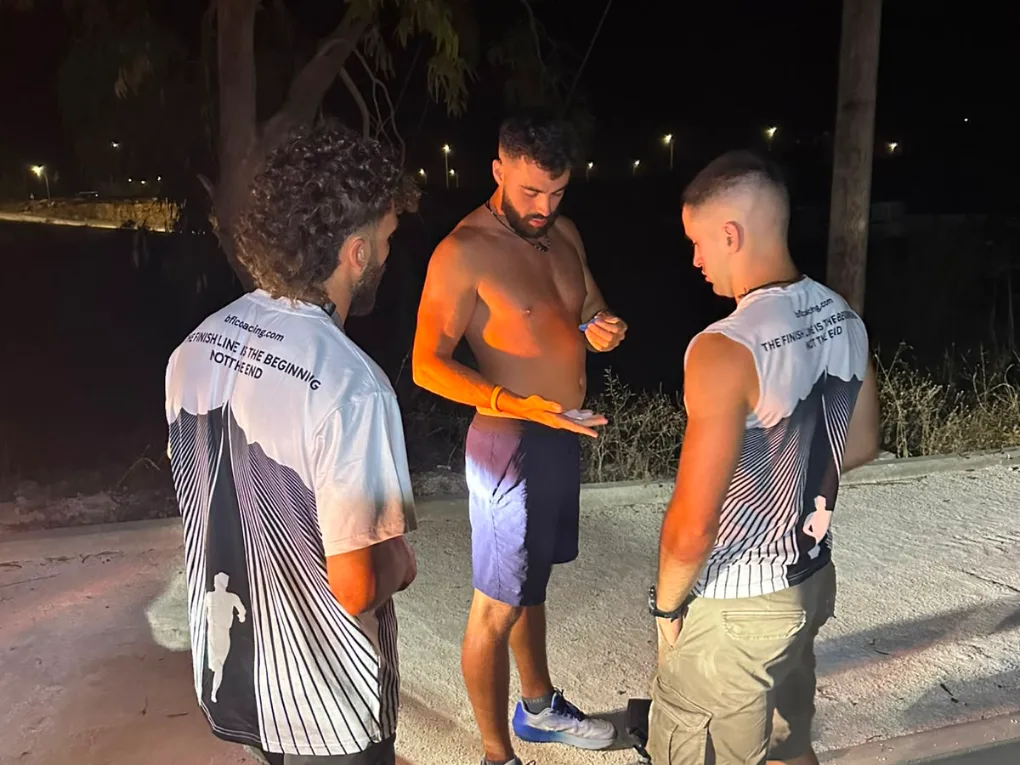
He covered 288.4 km between 20:00 and 06:00 at 8:39/km, a minute a kilometre faster than his daylight pace. The heat sheet explains why: through the middle of the week the afternoons were the part of the day worth sleeping through.
What eight days took out of him
Pre-event baselines, for context: 84 kg, lactate threshold heart rate 162, maximum 193, VO₂max 51. The heart-rate and VO₂max figures are the watch's own estimates, not laboratory measurements. He slept 6 h 18 m, 7 h 14 m and 8 h 11 m on the three nights before the start.
Twelve numbers that need no explaining
marathons back-to-back, without a rest day
climbed, 96 % of the height of Everest above sea level
calories burned. Three weeks of ordinary eating, in eight days
steps
spent running in 35 °C or hotter. It touched 40 °C
off the watch in eight days, and never off for an hour in the final twelve
of the week's 190 spent moving. More than half of eight days, on the move
his biggest twenty-four hours, and they were the first twenty-four
from the finish back to the start. He closed the island
his pace in the dark, a full minute quicker than his pace in daylight
the final two kilometres' moving pace, nearly two minutes quicker than the 700 before them
average speed across the entire week, sleep and all
What the data cannot tell you
A dossier is only as good as its disclosures. Everything below is a real limitation of the evidence, stated before anyone has to find it.
- There is no heart-rate data at all. All three files record none: heart-rate monitoring was switched off deliberately to conserve battery over eight days, a decision taken before the start. No cardiac drift, decoupling or aerobic-efficiency analysis is possible, and any such claim about this run would be invented. The heart-rate figures on sheet 13 are daily wellness readings, not from the run.
- 865 m of the route is not on the trace, at km 572.1, plus 84 m at km 595.1. Sheets 03 and 04 give the full accounting. This is 0.135 % of the distance and neither gap requires assistance to explain, but they are gaps and they are stated as such.
- No recount of the raw GPS independently confirms the distance. Sheet 04 sets out why: the answer follows the noise filter chosen, anywhere from 700 to 797 km. An earlier version of this dossier offered a 704.50 km recount as corroboration, within 0.36 % of the watch. It is withdrawn: that method re-anchored on any step over 500 m but not on the fixes after one, so the 865 m resume at km 572.1 dropped 69.69 km and 22.4 hours out of the count in silence, and the agreement was that undercount cancelling an overcount. The claim rests on the odometer and on the live tracker.
- Rest is inferred from a stopped watch. The device was in activity mode for the whole week, so it logged no sleep stages. Off-watch time is a proxy: he may have been awake for much of it.
- Elevation gain has two defensible values: 8,505 m from the device's own algorithm, 6,163 m from a 5 m-threshold recount, both stated on sheet 07. An earlier version of this dossier put the recount at 6,526 m, which contained 363 m of climb that never happened — the barometer failed in the last two minutes of the second recording and slid to −370 m, and the step back to +11.6 m where the third picks up reads as an ascent. Readings below −10 m now carry no altitude at all rather than a false one.
- Step count is estimated, not measured. Dividing the distance by the watch's own average stride gives 829,000; dividing it by the stride the recorded cadence implies gives 871,000, a 5 % spread. Cadence itself is missing for 121 km of the run, and the watch's own daily step count exists for only two of the eight days, one of which is obviously broken — 8,188 steps on a 79 km day.
- Calories are a device model, not measured expenditure, and no device model has been validated over 190 hours. Treat 52,186 as the watch's arithmetic.
- The training-load figures on sheet 13 land on one day, not eight. intervals.icu books an activity's whole load on the date it began, so all 2,646 TSS of the seven-day first file fell on 20 July. Chronic load jumped from 77 to 137 overnight and then fell every day of the run until the last, when the final morning's two files booked their own 231 TSS and lifted it to 122 at the finish; the 395 acute load and the −258 form reading are that same single day. The work was spread across the week. The accounting was not.
- Temperature is a wrist sensor in direct Cypriot sun, warmed further by skin contact. Good for exposure, not for meteorology, which is why sheet 10 carries an independent ambient record beside it rather than in place of it.
- The record is ratified. These figures are still ours. The attempt was reviewed and is listed as a verified Supported FKT for the Cyprus Coastline at 7 d 22 h 35 m 25 s. What that ratifies is the run: the route, the clock, and the continuity of the thing. It does not audit the derived work on these sheets. The climb, the moving time, the rest blocks, the training load and the ambient reconstruction are all computed here from the athlete's own device files, and an error in any of them would be ours rather than the reviewers'.